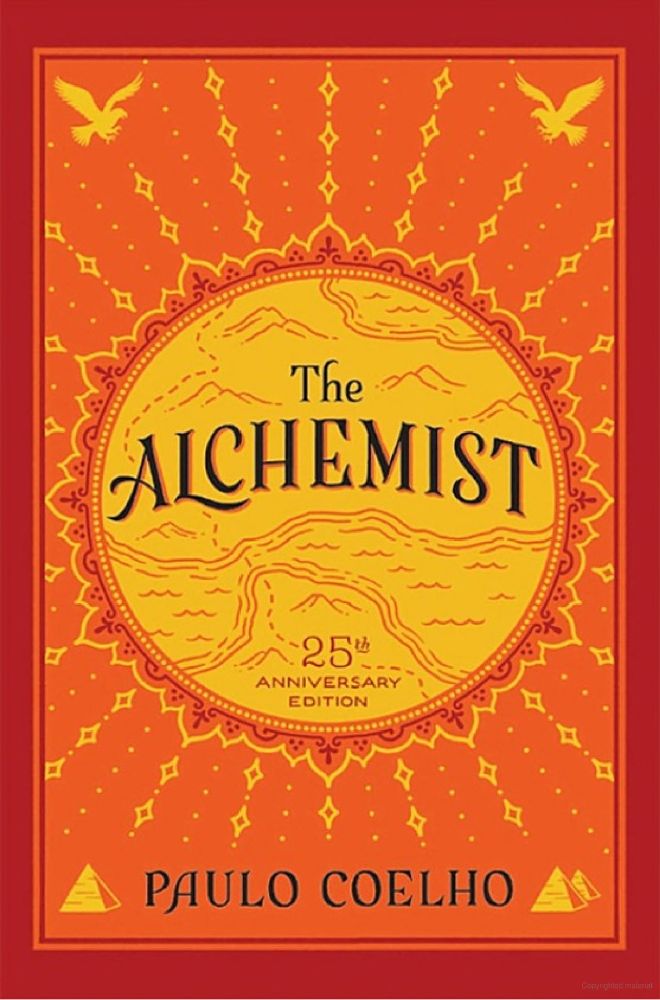
Summary of the Book Alchemist By Paulo Coelho

In "The Alchemist" Santiago, a shepherd from Spain, embarks on a journey to Egypt to find a hidden treasure guided by a recurring dream. Along the way, he learns about the "Soul of the World," a spiritual framework that connects all living and nonliving beings, and the concept of a "Personal Legend," the actual desire or goal each person wants to accomplish.
Dreams as Pathways to Desires: Santiago's recurring dream sets him on a path of self-discovery and fulfillment. The novel emphasizes that dreams are messages from the universe, reflecting our deepest desires and connecting us to the spiritual essence of the world.
Personal Legend: Melchizedek, a king disguised as an older man, introduces Santiago to the idea of a Personal Legend. This desire originates from the universe, and the universe will aid in its fulfillment. Santiago learns from an Englishman and a true alchemist that pursuing one's Personal Legend requires listening to the heart and overcoming superficial pursuits.
Love Does Not Equate to Possession: Santiago's love story with Fatima, a woman he meets at a desert oasis, explores the idea of love and possession. Fatima encourages Santiago to continue his journey, understanding that true love does not require possession. Santiago's interaction with the desert, wind, and sun, where he speaks the language of love, culminates in his becoming a true alchemist. The novel illustrates that love is embodied in the universe, and actual love trusts and frees rather than possesses.
The Journey to Self-Discovery: Santiago's journey takes him through various challenges, learning experiences, and encounters with diverse characters. He learns the importance of study and experience, the pitfalls of pursuing superficial rewards, and the courage to pursue one's dreams.
—
—
It’s Up to You to Follow the Markers of Your Destiny: The tension between fate and free will is a central theme in "The Alchemist." While the universe may predetermine our Legend, the novel emphasizes that we must recognize and follow the omens that guide us toward our destiny.
Omens are symbolic objects or events that provide guidance or insight into the future. Santiago encounters various omens throughout his journey, such as the two stones given by Melchizedek, the scarab beetle at the pyramids, and the vision of two hawks fighting. These omens are signposts from the universe, helping Santiago navigate his path.
The recurring phrase "Maktub," meaning "It is written," reinforces the idea of fate and destiny. However, the novel also explores the struggle and effort required to fulfill one's Personal Legend. If destiny is predetermined, why must we strive hard to achieve it? Why do some fail in their pursuit?
The answer lies in a conversation Santiago has with a camel driver. The camel driver explains that while the future may be known only to God, seers can interpret the omens of the present to shape the future. The key to fulfilling one's destiny is to live attentively in the present moment, recognizing and following the omens that guide us.
This theme underscores the novel's message that while the universe may conspire to help us fulfill our destiny, it is ultimately our responsibility to recognize the signs and make the choices that lead us to our Legend. The journey to self-discovery is not merely a passive acceptance of fate but an active engagement with the present, guided by the universe’s wisdom.
**
Final Summary: Let’s finish with a brief recap of the events and themes of Paulo Coelho’s novel "The Alchemist." Santiago, an Andalusian shepherd, embarks on a journey to the pyramids of Egypt, driven by a recurring dream he has had since childhood. Guided by the mysterious king Melchizedek, Santiago decides to pursue his destiny.
His journey is filled with setbacks and distractions. He is robbed and must rebuild his fortune by working in a crystal shop; a desert conflict impedes his progress; he befriends an erudite yet inexperienced Englishman, and he falls in love with Fatima. Along the way, he meets an alchemist who teaches him the importance of listening to his heart and connecting with the Soul of the World. When he finally arrives at the pyramids, his dream is proved prophetic, albeit roundabout.
"The Alchemist" grapples with profound themes of fate, destiny, love, and our place in the universe. It explores the tension between free will and predestination, the nature of love and possession, and the importance of recognizing and following the markers of our destiny. The novel's overarching message is that when we accept that we are one with the universe, we can achieve extraordinary feats and realize our deepest desires. Through Santiago's journey, Coelho encourages readers to embrace their Legends, listen to their hearts, and actively engage with the present moment to fulfill their unique destinies.